
Rust User Sentiment Split Following Announcement of Kernel-Level Security Implementation
러스트, ‘커널 단위 보안’ 도입 발표에 유저 여론 양분
2026.02.04 12:35 UTC+9

AI Summary
Rust, which celebrated its 12th anniversary last year, will introduce a kernel-level security system starting this March. On the 31st, Facepunch Studios COO Alister McFarlane announced via his social media that starting in March, playing Rust will require Secure Boot and TPM 2.0.
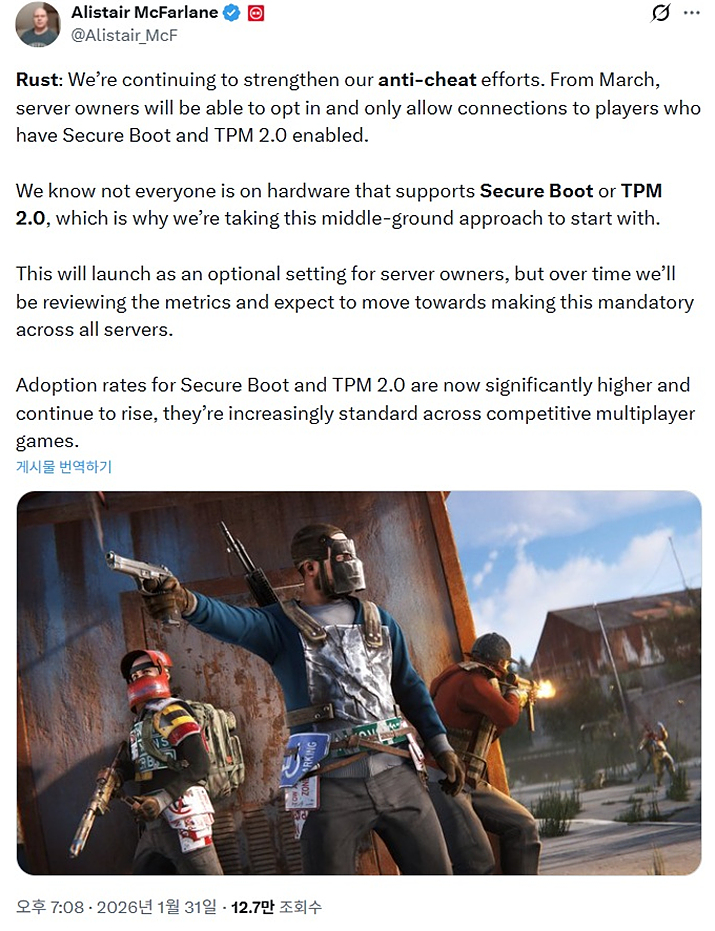
Rust, which celebrated its 12th anniversary last year, will introduce a kernel-level security system starting this March.
Facepunch Studios COO Alistair McFarlane announced on his social media on the 31st that starting in March, Rust will require Secure Boot and TPM (Trusted Platform Module) 2.0 for gameplay. This security system overhaul will first be applied as an optional setting for server owners, and will later be transitioned to a mandatory setting for all servers after reviewing relevant metrics.
These two elements are part of 'kernel-level security,' a security policy that has recently been spreading across competitive multiplayer games. This is at the same level as Riot Games' 'Vanguard' and the Call of Duty series' 'Ricochet,' and is also a technology required for booting Windows 11. Since both technologies verify system tampering in advance, they have the advantage of being harder to bypass than existing anti-cheat methods, and Facepunch Studios has stated its intention to put a fundamental stop to the cheat ecosystem through this.
However, as the news spread, controversy erupted in the Rust community. This is because there are ongoing concerns that users who cannot easily upgrade their hardware due to recent DRAM price hikes, as well as those using Linux and the Windows compatibility layer Proton, will inevitably be excluded. In fact, due to the impact of some anti-cheat systems, many online FPS games are difficult to play normally on the Steam Deck, leading to significant dissatisfaction.

Consequently, on communities like SNS and Reddit, cynical reactions are emerging, such as demands that "actual observed data before and after the system application should be disclosed so users can be convinced," as well as claims that "the responsibility for failing to stop cheats is being shifted to the users" and "are they abandoning gamers without money?" On the other hand, positive opinions are also being raised, such as "long-time players will likely support this policy" or "it is worth enduring if it definitely reduces cheaters."
Meanwhile, COO McFarlane added context to the strengthening of the security system, explaining, "We are aware that not all users are using hardware that supports Secure Boot and TPM 2.0, so we chose an intermediate approach first," and "The adoption rate of Secure Boot and TPM 2.0 is already quite high and is continuously increasing. These technologies are gradually becoming the standard in competitive multiplayer games."
지난해 12주년을 맞은 러스트가 오는 3월부터 커널 단위 보안 체계를 도입한다.
페이스펀치 스튜디오 COO 알리스터 맥팔레인은 지난 31일 자신의 SNS를 통해, 3월부터 러스트 플레이 시 보안 부팅(Secure Boot)과 TPM(Trusted Platform Module) 2.0을 요구할 것이라고 밝혔다. 이번 보안 체계 개편은 서버 소유자를 위한 선택적 설정으로 우선 적용되며, 이후 관련 지표를 검토한 뒤 전 서버 필수 설정으로 전환될 예정이다.
두 요소는 최근 경쟁 중심의 멀티플레이 게임 전반에서 확산되고 있는 보안 정책인 ‘커널 단위 보안’의 일환이다. 이는 라이엇게임즈의 ‘뱅가드’, 콜 오브 듀티 시리즈의 ‘리코셰’와 동일한 수준으로, 윈도우 11 부팅을 위해서도 필수적으로 요구되는 기술이다. 두 기술 모두 시스템 변조 여부를 사전에 검증하기 때문에 기존 안티치트 방식보다 우회가 어렵다는 장점이 있으며, 페이스펀치 스튜디오는 이를 통해 치트 생태계에 근본적인 제동을 걸겠다는 입장을 내세웠다.
하지만 해당 소식이 전해지자 러스트 커뮤니티에서는 논란이 촉발됐다. 최근 DRAM 가격 상승 등으로 하드웨어 업그레이드가 쉽지 않은 이용자들을 비롯해, 리눅스 및 윈도우 호환 레이어인 프로톤 기반 사용자들이 배제될 수밖에 없다는 지적이 이어지고 있기 때문이다. 실제로 일부 안티치트 시스템의 영향으로 스팀덱에서는 다수의 온라인 FPS 게임을 정상적으로 플레이하기 어려운 상황이 지속되고 있어, 이에 대한 불만도 적지 않은 실정이다.
이에 SNS와 레딧 등 커뮤니티에서는 “시스템 적용 전후의 실제 관측 수치를 공개해 유저들이 납득할 수 있도록 해야 한다”는 요구를 비롯해, “치트를 막지 못한 책임을 유저에게 전가한다”, “돈 없는 게이머는 버리는 것이냐”는 냉소적인 반응이 나오고 있다. 반면 “오래 게임을 즐긴 유저일수록 이번 정책에 찬성할 것”이나, “치터가 확실히 줄어든다면 감수할 만하다”는 긍정적인 의견도 함께 제기되고 있다.
한편 맥팔레인 COO는 “모든 유저가 보안 부팅과 TPM 2.0을 지원하는 하드웨어를 사용하고 있는 것은 아니라는 점을 인지하고 있어, 우선 중간적인 접근 방식을 선택했다”며 “보안 부팅과 TPM 2.0의 도입률은 이미 상당히 높고 지속적으로 증가하고 있다. 이러한 기술은 경쟁 멀티플레이어 게임에서 점차 표준이 되어가고 있다”고 설명하며 이번 보안 체계 강화의 배경을 덧붙였다.
This news was translated by AI.

I am dedicated to games and writing. viina@gamemeca.com
READ MORE
-
 Arknights Collaboration Cafe Opens at Animate in Hongdae and Busan
-
 Is something big coming? Nikke 4th Anniversary Special Broadcast to air on the 24th at 7 PM
-
 "Cannot even log in" Steam blockades intensify in Vietnam
-
 Attracting Investment and Testing Together, Gyeonggi Game Audition to Be Held on the 15th
MOST POPULAR NEWS
- [G-STAR 26] CDPR Joins, Full Outline of Participating Companies Revealed
- Cats and Soup Festival to Open at Starfield Hanam for its 10th Anniversary
- KRAFTON Suspends Development of Extraction Shooter [PUBG: Black Budget]
- [Today's steam] Ace Combat 8 hits No. 1 in popularity from early play
- Celebrating 30th Anniversary, McDonald's Happy Meal 'Pokemon Card' Coming Soon
- ArcheAge Chronicles to Reveal PvP at Steam Next Fest
- To Curb Political Controversy, Paradox Prohibits 19th-to-20th Century Historical Figure Profiles
- EU Reveals 'Ultra-Strong' Game and SNS Regulations for Youth Protection
- Phantom Blade Zero and Call of Duty Lead a Wave of Blockbusters: October's Most Anticipated Games
- [Game Rank Analysis] Genshin Impact Returns as the Subculture Emperor, Surpassing Wuthering Waves
MEDIA PARTNERSHIPS



GAMEMECA SNS


 GAMEMECA GLOBAL SITE