"Many foreign game companies are leaving" Domestic agent blind spot
“빠져나가는 해외 게임사 많다” 국내 대리인 사각지대
2026.10.12 14:54 UTC+9

AI Summary
The audit revealed loopholes in local representative rules for overseas firms.
Only a fraction of repeatedly penalized publishers fall under current mandates.
Authorities plan to discuss stricter measures to close these regulatory gaps.
Look, let's be honest about the domestic representative designation system implemented last October, which forces overseas gaming companies of a certain scale to appoint a local representative to keep them playing by local rules. Now that it has hit its one-year mark, critics are pointing out that the current thresholds leave plenty of loopholes for overseas publishers to slip right through, meaning the net needs to be cast much wider.
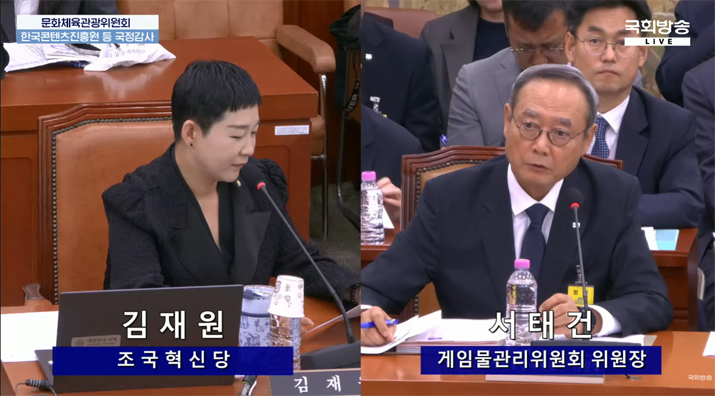
During the Culture, Sports and Tourism Committee audit held on October 12, Representative Kim Jae-won of the Rebuilding Korea Party cornered Game Rating and Administration Committee Chairman Seo Tae-gun, highlighting gaping blind spots in the domestic representative designation system. Kim zeroed in on the metric of 'user count'. Under current legislation, overseas game companies are required to appoint a local representative if they pull in an annual revenue of at least 1 trillion won or rack up an average of 1,000 daily installs. Crucially, the installation count is calculated per individual game, rather than being pooled across the entire company.
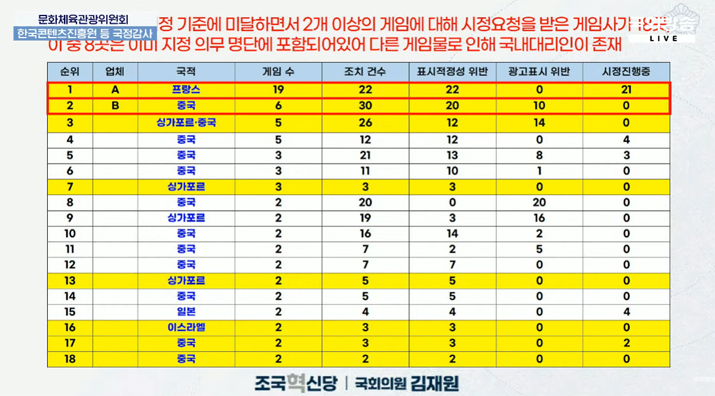
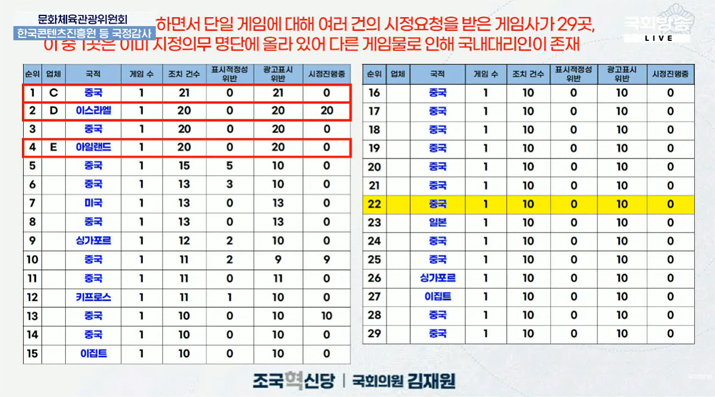
Touching upon the installation count, Kim pointed out that "publishers running multiple small-scale games slip right through the designation net even if their total pooled user base is massive. Over the past three years, out of the game companies receiving corrective requests from the Game Rating and Administration Committee, 18 failed to meet the designation criteria for revenue and installs yet racked up corrective requests across two or more games, and 8 of them ended up on the mandatory designation list solely due to entirely different titles." Meanwhile, 29 overseas publishers failed to meet the local representative designation requirements for even a single game while repeatedly receiving anywhere from 21 down to 10 corrective requests from the committee.
Kim emphasised that "out of 277 overseas companies receiving corrective requests over the past three years, a paltry 40—just 14 percent—actually sit on the mandatory designation list. It feels like the target scope itself was drawn up far too narrowly. Even if they fail to meet the statutory benchmarks, companies that repeatedly face corrective actions need to be dragged in and designated anyway."
Responding to this critique, Game Rating and Administration Committee Chairman Seo Tae-gun stated, "I completely agree with the points raised by the honourable representative. At present, we lack the legal basis to take special enforcement action against overseas corporations that repeatedly receive corrective requests. We will consult closely with the competent ministry, the Ministry of Culture, Sports and Tourism, to figure out a way forward."
On a related note, a partial amendment to the Game Industry Promotion Act spearheaded by Representative Kim Jae-won to beef up user protection duties for overseas gaming companies sailed through the National Assembly plenary session on October 1st. The amendment introduces new compliance obligations for game providers to safeguard domestic user welfare and handle grievances, while stipulating that when designating a local representative, priority must be given to domestic corporations established or effectively controlled by the business in question. Furthermore, it slaps game operators with duties to manage and supervise their domestic representatives and maintain their designation, empowering authorities to issue corrective orders if the representatives fail to pull their weight.
작년 10월에 시행된 국내 대리인 지정 제도는 일정 규모 이상의 해외 게임사에 국내 대리인을 두도록 의무화하여 국내법을 지키도록 하는 것이다. 시행 1년을 맞이한 현재, 현행 기준으로는 법망에서 벗어난 해외 게임사가 많아 적용 범위를 넓혀야 한다는 지적이 제기됐다.
조국혁신당 김재원 의원은 10월 12일 열린 문화체육관광위원회 국정감사에서 게임물관리위원회(이하 게임위) 서태건 위원장을 대상으로 국내 대리인 지정 제도에 사각지대가 있음을 지적했다. 김재원 의원이 구체적으로 지적한 것은 ‘이용자 수’다. 현행법에서 국내 대리인을 지정해야 하는 해외 게임사는 연 매출 1조 원 이상이거나, 하루 평균 설치 1,000건 이상을 기록한 게임을 서비스하는 곳이다. 설치 건수는 게임사를 합산한 것이 아니라, 게임 개별로 따진다.
이 중 설치 건수에 대해 김재원 의원은 “소규모 게임을 여러 개 서비스하는 사업자는 합산 이용자가 많아도 (국내 대리인) 지정에서 빠지게 된다. 최근 3년간 게임위로부터 시정요청을 받은 게임사 중 지정 기준(매출과 설치 건수)을 미달하면서 2개 이상 게임에서 시정요청을 받은 게임사가 18곳이며, 이중 8곳은 다른 게임으로 지정 의무 명단에 포함된 업체다”라고 밝혔다. 게임 1개에 대해서도 국내 대리인 지정 조건을 충족하지 못한 해외 게임사 29곳이 21건에서 10건까지 반복해서 게임위 시정 요청을 받았다.
김재원 의원은 “최근 3년간 시정 요청을 받은 해외 업체는 277곳인데 지정 의무 명단에 있는 곳은 14%인 40곳뿐이다. 대상 범위 자체가 너무 좁게 설계되어 있다는 생각이 든다. 이처럼 여러 번 시정 조치를 받은 경우에는 법령상 기준에 미치지 못한다고 하더라도 추가로 지정하도록 해야 한다”라고 강조했다.
이러한 지적에 대해 게임위 서태건 위원장은 “의원님이 지적하신 부분에 대해 전적으로 공감한다. 현재 반복적으로 시정 요청을 받은 해외 기업에 대해서는 특별한 조치를 할 수 있는 근거가 아직 없다. 이러한 부분에 대해서는 주무부처(문화체육관광부)와 협의해서 처리할 수 있도록 하겠다”라고 답변했다.
한편 10월 1일 김재원 의원이 대표발의한 해외 게임사 국내 이용자 보호 의무를 강화하는 게임산업진흥에 관한 법률 일부개정안이 국회 본회의를 통과한 바 있다. 게임사업자 준수 사항에 국내 이용자 피해 보호와 불만 처리 의무를 신설하고, 국내 대리인 지정 시 해당 사업자가 설립하거나 지배적 영향력을 행사하는 국내 법인을 우선 지정하도록 했다. 아울러 게임사업자에게 국내 대리인에 대한 관리감독과 지정 유지 의무를 부과하고, 대리인이 의무를 이행하지 않을 경우 시정명령을 내릴 수 있도록 했다.
This news was translated by AI.

Let's not lose our initial resolve. Meticulously, one by one. risell@gamemeca.com
READ MORE
-
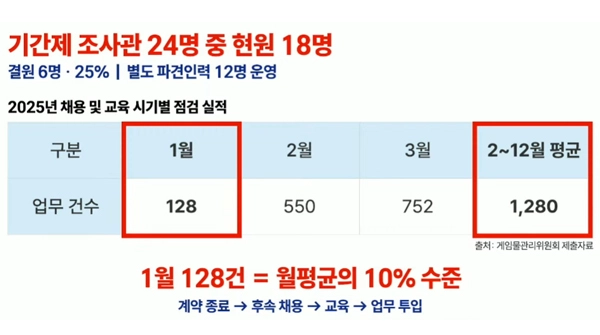 Short-Term Contract-Centric RNG Item Monitoring Structure Pointed Out at National Audit
-
 Nier Developer Yoko Taro Says "I Don't Have Any Particular Works I Want to Make in the Future"
-
 Lineage 2 New OST Album Released, Reinterpreted with Lo-Fi Jazz
-
 Celebrating 19 Years of Music: Assassin's Creed Symphony Concert Scheduled for November
RECOMMENDED NEWS
MOST POPULAR NEWS
- [Today's steam] Aion 2 Records 400,000 Concurrent Players Upon Official Launch
- Is something big coming? Nikke 4th Anniversary Special Broadcast to air on the 24th at 7 PM
- "Cannot even log in" Steam blockades intensify in Vietnam
- [Today's steam] Valve's new title 'Deadlock' surpasses 230,000 Concurrent Players
- Representative Cho Seung-rae: "Gamescom's Strength is Strong B2B, Desperately Needed for G-Star"
- Pre-load starts for World of Dokkaebi, releasing on October 8
- 'Dave the Diver' Complete Edition Released with All Expansions
- [Cartoon] The arrival of the sharpshooter 'Aion 2'?
- "Destined to Disappear Anyway" CyberConnect2 CEO Supports Abolishing Physical Discs
- Dokkaebi World Achieves Number 1 Popularity on Both Major App Markets on Launch Day
MEDIA PARTNERSHIPS



GAMEMECA SNS


 GAMEMECA GLOBAL SITE