Nexon Games Director Kim Yong-ha advocates for a cautious, pragmatic approach to AI in gaming. He emphasizes that creators must prioritize authenticity and gamer consensus over simple efficiency. Future developers should evolve into coordinators who leverage AI to bridge diverse creative disciplines.
Last year, 'Generative AI' became an unavoidable force in the game development landscape, yet it remains a deeply divisive topic. Within the industry, proponents champion it as the future, while dissenters raise alarm over the inevitable decline in quality and rampant misuse. Gamers are just as split; some simply couldn't care less as long as the end product shines, while others have already resorted to review bombing games they suspect of using AI tools.
With the debate raging on, we wondered: what do the leading figures of Korean game development actually think? As we head into 2026—a year expected to bring even more AI-driven upheaval—Gamemeca sat down with the industry's top minds to dissect the current state and future prospects of generative AI.
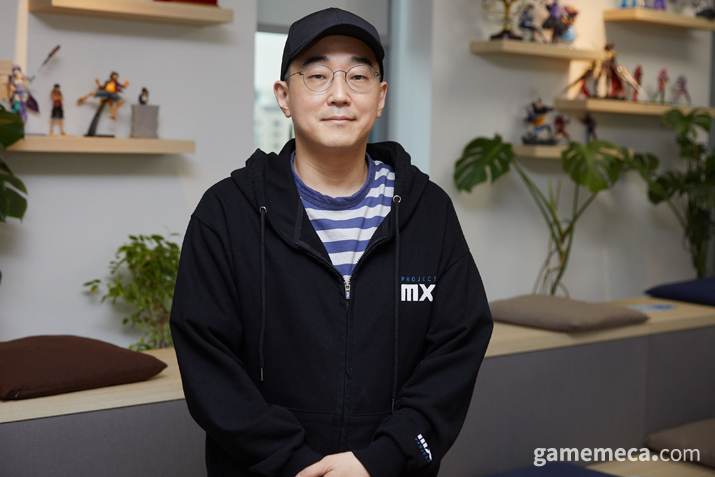
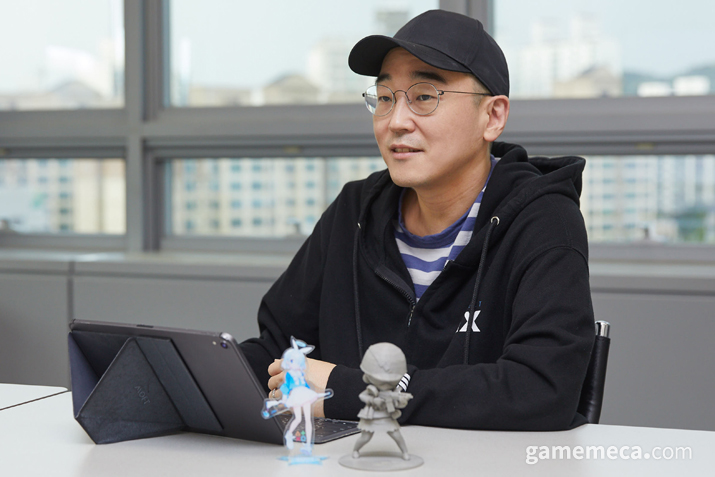
▲ Nexon Games IO Division Director Kim Yong-ha (Image courtesy: Nexon Games)
Nexon Games Division Director Kim Yong-ha has cemented his status as a titan of the domestic subculture genre through his work on Blue Archive. Since 2024, he has led the 'IO Division,' a dedicated subculture development unit at Nexon Games, currently juggling the live service of Blue Archive and the development of their new title, Project RX.
Kim maintains a pragmatic yet cautious outlook on generative AI. He fears that because subculture fans prize 'creator sincerity' above all else, AI-generated content lacking human intent might end up feeling like 'a bag of chips filled with nothing but nitrogen'—all packaging and no substance. He stresses that before we dive headfirst into AI-driven creativity, establishing a genuine consensus with players is a must.
That said, he views AI as a potent tool for efficiency and is already putting it to work. His team even has an internal group dedicated to building custom AI solutions, from refining legacy project data to streamlining communication to slash overhead. Looking forward, he predicts that the role of a 'coordinator'—a director capable of leveraging their core expertise to manage adjacent fields—will become the gold standard for developers.
Q: How would you evaluate the current AI adoption rate within the Nexon Games IO Division?
Nexon Games Division Director Kim Yong-ha: The IO Division has already integrated usable AI tech like speech recognition and synthesis into our games, and we are constantly monitoring the field for new applications. We aren't looking to force a radical 'AI-first' overhaul of our entire organization; instead, we approach it pragmatically—identifying what our devs actually need and building or providing tools to solve those specific pain points.
Q: In which areas are you primarily using it?
Nexon Games Division Director Kim Yong-ha: It's quite broad. We categorize our AI services into two buckets: enterprise-level services (and APIs) provided by the company, and internal services developed in-house by our division.
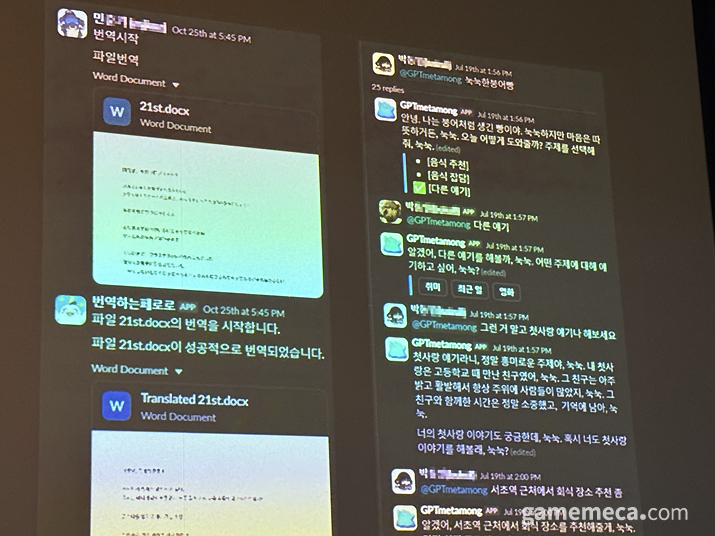
We use enterprise tools for groupware-linked searches, drafting documents, research, and programming assistance. Our custom-built services focus on things like automated translation, meeting minutes, and voice synthesis—things the dev team consistently asks for.
▲ Internal communication tools introduced by Director Kim at the Content Creative Talent Support Program special lecture last July (Image Source: Gamemeca)
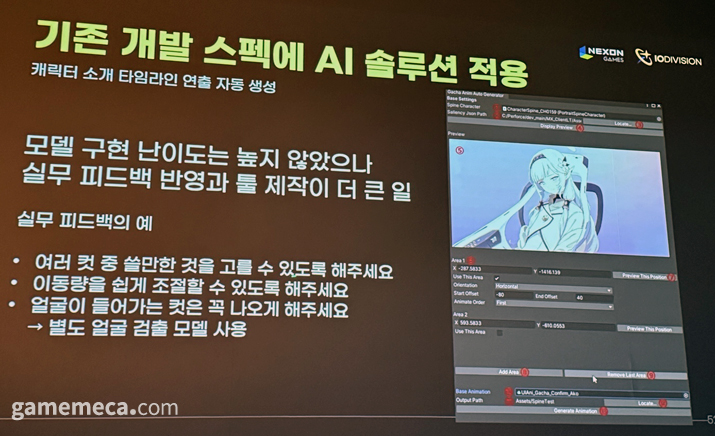
▲ An example of an automatically generated timeline for Blue Archive character introductions (Image Source: Gamemeca)
Q: Recently, gamers have shown hostility toward AI-generated assets, citing 'infringement on the creator's domain' and 'soulless content.' Do you believe this backlash impacts the reception of game content or its revenue?
Nexon Games Division Director Kim Yong-ha: I empathize with the players' concerns, and yes, I certainly believe it affects content reception. I’d break this down into two points.
First, there is the 'AI slop' problem—the decline in quality caused by reckless AI usage. To use the snack analogy again, if the packaging looks great but the actual content is replaced by nitrogen, consumers are naturally going to push back.
Second, subculture fans have high expectations for 'creative sincerity.' Current transformer and diffusion-based models are merely simulators, not entities with intent or personality. If you rely entirely on them to churn out assets with a single click, you have to ask: 'Can there really be any creative sincerity in that?'
* Transformer: The core blueprint of neural networks designed to grasp the relationships between words in a sentence and overall context; the underlying tech for LLMs like ChatGPT.
* Diffusion: A method that starts with random noise (dots) and gradually erases it to create a sharp image; the core technology for image and video generation.
▲ Director Kim places great importance on imbuing subculture titles with 'creator sincerity' (Image courtesy: Nexon Games)
Q: Do you anticipate that the quality and originality of AI-generated illustrations, videos, and voices will completely replace human creators in the near future, or will it remain merely an assistive tool?
Nexon Games Division Director Kim Yong-ha: It depends on how you define the 'near future,' but looking at the current trajectory, I do expect AI to eventually replicate everything humans can do. Many experts suggest we might hit that point within 5 to 10 years. Whether AI can ever possess something akin to a personality or sincerity is a deep, existential question about what it means to be human, which is probably beyond our scope here.
Let's stick to a one-year outlook. By that standard, my answer is 'no.' AI still fails to generate the level of quality required for key assets in a professional development environment. I don't expect it to meet those expectations by next year. However, it is undeniably becoming a more versatile tool.
Q: Is the company considering any transparency guidelines or efforts to mitigate gamer resistance?
Nexon Games Division Director Kim Yong-ha: If we set conservative standards based on domestic and international precedents, I think it's fair to use it for research and brainstorming. However, as I mentioned, it's still too early and risky to introduce AI into the production of creative assets. We are very concerned about whether players would accept it, so prior disclosure is essential. Establishing concrete guidelines will require building a real consensus between the industry and the players.
▲ It is high time to consider building a consensus on AI disclosure guidelines (Image Source: Pixabay)
Q: What is the biggest strength of AI in game development, and where is it maximizing efficiency?
Nexon Games Division Director Kim Yong-ha: Modern games are complex systems that must organically integrate narrative, audiovisuals, and IT. Yet, knowledge on how to build or assemble these components—or how to troubleshoot them—is often not passed down systematically. The biggest advantage of AI is its ability to refine and distill existing best practices and guidelines. It has made planning and retrospection significantly faster and more accurate.
Also, communication costs balloon as dev teams grow. Documenting, updating, and sharing work history is vital but painful. AI contributes massively to streamlining these tasks.
Q: Conversely, what do you see as the clear limitations of current AI technology?
Nexon Games Division Director Kim Yong-ha: Technically, we face a lack of continuous learning, constraints on context input, performance limits in modalities other than text (like image, audio, video), and the astronomical costs of training and usage.
Creatively, it still lacks the ability to propose something truly novel—that 'something new that never existed before'—that humans prefer. Current generative AI research prioritizes producing results that align with verifiable truths and public consensus.
Furthermore, it can answer like an expert in one area and then give nonsensical responses in common-sense fields, or hallucinate. It lacks the consistency of a human.
Therefore, instead of a blanket 'let's use AI for everything!' approach, we need to apply it locally and specifically.
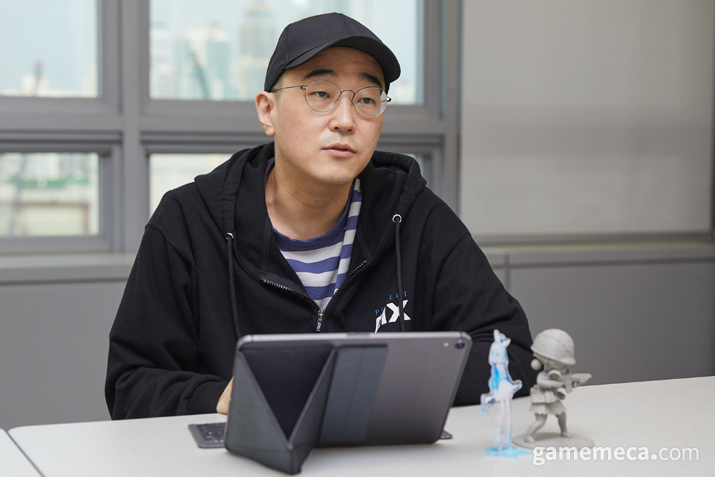
▲ Director Kim insists on setting specific limits on AI application at this stage (Image courtesy: Nexon Games)
Q: How far do you expect AI usage to expand in game development over the next 3 to 5 years?
Nexon Games Division Director Kim Yong-ha: I can see the path for the next year, and I expect one or two of the limitations mentioned earlier to be resolved or improved.
Looking at 3 years or more, we need a different perspective. Not only is AI being developed that can generate entire gameplay environments—like Google DeepMind's Genie 3—but we have entered an era where a solo developer can create a playable game just by prompting an AI model.
Based on this, I expect the scope for solo developers to widen and the quality to skyrocket. Google DeepMind has already teased early-stage games created this way; I feel both excitement and anxiety about what we might see in three years.
I expect a future where major games, armed with famous IP and high-quality production, coexist at one extreme with highly personalized, novel indie games at the other.
▲ Google DeepMind 'Genie 3' introduction video (Video Source: Google DeepMind Official YouTube Channel)
Q: There are many concerns that AI will shrink jobs in fields like art, QA, and planning. What is your take?
Nexon Games Division Director Kim Yong-ha: If AI development continues at this pace, it won't be just a niche industry problem; it will become a broader issue regarding jobs and social systems for all of us in the medium to long term.
However, for now, the Korean game industry is actually suffering from a talent shortage. It’s hard to find the right people for each position, and it takes time. The IO Division is not considering downsizing recruitment due to AI adoption.
Q: Do you agree with the view that AI will not replace jobs, but rather transform existing roles or create new ones?
Nexon Games Division Director Kim Yong-ha: I agree that the work environment and the nature of the jobs themselves will change.
Q: As a game developer, what new competencies or education do you think will be required for the AI era?
Nexon Games Division Director Kim Yong-ha: The ability to define a task from scratch and communicate with colleagues will become more critical than the ability to execute a well-defined task precisely. While maintaining depth in one's specialization, the role of a 'coordinator' or 'director' who can leverage AI tools to cover adjacent fields will become paramount.
While this change offers individual growth opportunities, it can also bring psychological pressure to keep pace with the rapid speed of evolution. Organizations must focus on alleviating the burden of adaptation and bridging the educational gap for their members.
Q: What is your ultimate goal to achieve through AI technology?
Nexon Games Division Director Kim Yong-ha: One of the core missions of the IO Division is to 'realize an otherworldly experience you want to step into.' I hope new technologies like AI can contribute to bringing that ideal to life more faithfully.
작년에 게임 개발 환경에서 ‘생성형 AI’ 활용은 거부하기 어려운 흐름으로 자리잡았다. 그럼에도 이에 대한 찬성과 반대는 엇갈리고 있다. 게임업계에서도 ‘AI 활용이 미래’라며 적극적인 도입을 주장하는 측이 있는 반면, AI 남용으로 인한 질적하락 등에 대한 우려를 드러내며 반대하는 의견이 팽팽히 맞서고 있다 게이머 사이에서도 결과물만 좋다면 AI 사용 여부는 크게 상관이 없다는 반응부터, AI를 사용해 개발한 게임에 불매운동을 벌인다는 부정적인 의견까지 편차가 크다.
이처럼 생성형 AI에 대한 찬성과 반대가 엇갈리는 와중, 국내 유명 게임 개발자나 개발사 대표들은 이에 대해 어떻게 생각하고 있을까? 게임메카는 AI로 인한 변화가 한층 더 커질 것으로 예상되는 2026년을 맞이해, 국내 대표 게임 개발자를 초빙하여 생성형 AI 활용에 대한 현황과 앞으로의 전망을 들어보는 시간을 마련했다.
넥슨게임즈 김용하 본부장은 블루 아카이브를 바탕으로 국내 서브컬처 게임업계 대표 개발자로 자리매김했다. 2024년부터는 넥슨게임즈 서브컬처 전문 개발조직 ‘IO본부’를 이끄는 본부장으로 활약하고 있으며, IO본부에서는 블루 아카이브 라이브 서비스와 함께 신규 타이틀 ‘프로젝트 RX’ 개발에 매진 중이다.
김용하 본부장은 생성형 AI에 대해 실용적이면서도 조심스러운 태도를 견지했다. 서브컬처 장르를 좋아하는 게이머는 '제작자의 진정성'을 중시하는데, 제작자의 의도가 결여된 AI 결과물은 팬들에게 자칫 ‘포장만 멋진 질소 가득한 과자’처럼 비칠 수 있다’고 우려했다. 따라서 그는 크리에이티브 영역에 AI를 본격 도입하기에 앞서, 게이머와의 공감대 형성이 선행되어야 한다고 강조했다.
다만 AI는 개발 효율을 높이는 유용한 도구라고 판단하고 있으며, 실제로도 이를 적극 활용 중이다. 개발팀이 필요한 부분을 자체 개발해서 제공하는 내부 조직도 존재한다. 기존 사례를 정제해서 돌아보며 향후 계획을 잡거나, 구성원 간 소통을 원활하게 하여 커뮤니케이션 비용을 줄이는 등이다. 그는 향후에는 개발자들에게 자신의 전문성을 바탕으로 인접 분야까지 아우르는 '조율자(디렉터)'로서의 역량이 중요해지리라 내다봤다.
Q: 현재 넥슨게임즈 IO본부의 AI 활용률은 어느 정도라고 평가하나?
넥슨게임즈 김용하 본부장: IO본부는 음성 인식, 음성 합성 등 활용 가능한 AI 기술을 게임에 실제로 적용해 왔으며, 현재도 AI 기술 발전 현황을 적극적으로 파악하며 적용 방안을 고민하고 있다. 다만, 조직 전체를 AI 중심으로 급격하게 ‘전환‘하기보다는 개발자들의 니즈를 먼저 파악하고, 이를 충족시킬 수 있는 기술을 개발하거나 서비스로 제공하는 실용적인 측면에서 접근 중이다.
Q: 어떤 분야에 주로 사용하고 있는가?
넥슨게임즈 김용하 본부장: 광범위하게 사용하고 있는 편이다. 주로 사용하는 AI 서비스를 크게 나누면, 회사 차원에서 제공하는 엔터프라이즈 서비스(및 API)와 본부 차원에서 자체 개발해 제공하는 내부 서비스가 있다.
엔터프라이즈 서비스는 그룹웨어(통합 업무용 소프트웨어)와 연동된 검색, 문서 작업 지원, 자료 조사, 프로그래밍 보조 등에 활용한다. 자체 개발 서비스는 자동 번역, 회의록 작성, 음성 합성 등 개발팀 필요에 맞춰 기능을 지속적으로 추가 중이다.
▲ 작년 7월에 열린 콘텐츠창의인재동반사업 오픈특강에서 김용하 본부장에 소개했던 사내 커뮤니케이션 툴 (사진: 게임메카 촬영)
▲ 블루 아카이브 캐릭터 소개 타임라인 자동 생성 사례 (사진: 게임메카 촬영)
Q: 최근 일러스트 등 AI 사용 결과물에 대해 게이머들이 '창작자의 고유 영역 침해', '영혼 없는 콘텐츠' 등을 이유로 삼아 반감을 보이는 현상이 있다. 이에 대해 어떻게 생각하는지, 게이머들의 반감이 게임 콘텐츠의 수용도나 매출에 미치는 영향이 있다고 보는지 궁금하다.
넥슨게임즈 김용하 본부장: 게이머들의 우려에 공감하며, (콘텐츠 수용도 등에) 당연히 영향도 있다고 생각한다. 이에 대해 두 가지 측면에서 말씀드리고 싶다.
첫 번째로, 무분별한 생성형 AI 사용으로 인해 결과물의 품질이 저하되는 AI 슬롭(slop) 문제다. 과자를 예로 들면 포장은 그럴 듯 하지만, 실제 과자의 함량이 줄어들고 질소로 바뀐다면 소비자 입장에서는 당연히 반발할 수밖에 없다.
두 번째로, 서브컬처 장르 소비자들은 '크리에이티브의 진정성'에 대한 기대가 높다. 반면, 현재의 트랜스포머나 디퓨전 기반 모델들은 의도나 인격을 가진 존재가 아닌 일종의 시뮬레이터일 뿐이다. 여기에 전적으로 의존하여, 이른바 ‘딸깍’으로 결과물을 내어 놓는다면, '과연 거기에 창작자의 진정성을 담을 수 있는가?'라는 의문을 가질 수 있다고 생각한다.
* 트랜스포머: 문장 속 단어들의 관계와 전체 맥락을 한눈에 파악하도록 설계된 인공신경망의 핵심 설계도, 챗GPT 등 LLM의 근간이 되는 기술
* 디퓨전: 무작위의 노이즈(점)에서 시작해 이를 지워나가며 점진적으로 선명한 이미지를 만들어내는 방식, 이미지나 영상 생성 영역 핵심 기술
▲ 김용하 본부장은 서브컬처 장르에 대해 '제작자의 진정성'을 담는 것을 중요하게 여긴다 (사진제공: 넥슨게임즈)
Q: 일러스트, 영상, 음성 등 AI가 생성한 콘텐츠의 품질과 독창성이 가까운 미래에 인간이 만든 창작물을 완전히 대체할 수 있을 것이라 예상하나? 아니면 AI는 인간을 돕는 보조 도구에 머무를 것이라 보는가?
넥슨게임즈 김용하 본부장: '가까운 미래'의 정의에 따라 다르겠지만, 최근 가속화되는 AI 발전 추이를 보면 결국 인간이 할 수 있는 모든 것을 AI가 해낼 수 있을 것으로 예상한다. 많은 전문가가 5년에서 10년 이내에 그런 시점이 올 것이라 전망하고 있다. AI가 인격에 준하는 무언가와 진정성을 가질 수도 있겠으나, 이 논의는 ‘인간 존재의 의미란 무엇인가’라는 본질적인 이야기로 이어질 것이기에, 여기서 깊게 다룰 주제는 아닌 것 같다.
현재를 바탕으로 1년 뒤까지만 가늠할 수 있을 것 같다. 이 기준으로 말씀드린다면 제 의견은 '아니오'다. 핵심적인 소재는 AI가 아직 개발 현장에서 요구되는 수준의 결과물을 온전히 생성하지 못하고 있다. 내년에도 기대에 부합하는 성능에는 미치지 못할 것으로 전망한다. 다만, 유용한 도구로서의 쓰임새가 확장되고 있다는 점은 틀림없는 사실이다.
Q: 게이머들의 거부감을 줄이기 위해 회사 차원에서 투명성 확보를 위한 노력이나 가이드라인 마련을 고려하고 있는가?
넥슨게임즈 김용하 본부장: 국내외 개발사 사례를 바탕으로 보수적인 기준을 잡는다면, 자료 조사와 브레인 스토밍 수준에서는 활용할 수 있지 않을까 한다. 그러나, 위에서 말씀드린 바와 같이 크리에이티브 소재 제작에 본격적으로 AI를 도입하는 것은 아직 이르며, 더 조심스럽다. 도입 시 ‘과연 게이머에게 수용될 수 있는가?’에 대해 우려되는 부분이 많은데, 이에 대한 사전 고지가 필요하다고 생각한다. 이에 대한 구체적인 가이드라인을 만들기 위해서는 게이머와 업계의 컨센서스(공감대) 형성이 필요할 것이다.
▲ AI 사전 고지 가이드라인에 대해 공감대 형성을 고민해볼 시기가 왔다 (사진출처: 픽사베이)
Q: 게임 개발 분야에서의 AI의 가장 큰 강점은 무엇이며, 어떤 부분에서 개발 효율성을 극대화하고 있다고 보는가?
넥슨게임즈 김용하 본부장: 현대의 게임은 서사, 시청각, IT 기술을 유기적으로 결합해야 하는 상당히 복잡한 시스템이다. 그럼에도 개별 요소를 어떻게 만들고 조립해야 좋은지, 어떤 경우에 문제가 발생하는지에 대한 지식이 체계적으로 전승되지 못하는 경우가 많다. AI의 가장 큰 장점은, 흩어져 있는 기존 모범 사례와 지침을 정제하고 알려주는 매우 강력한 도구라는 점이다. 덕분에 보다 빠르고 정확하게 계획하고, 회고할 수 있게 됐다.
또한, 개발 조직이 커질수록 커뮤니케이션 비용도 증가한다. 작업 내역을 꾸준히 문서화하고, 갱신 및 공유하는 것은 중요하지만 매우 고통스러운 작업이다. AI는 이런 작업을 효율화하는 데 크게 기여할 수 있다.
Q: 반면, 현재 AI 기술이 가진 명확한 한계점은 무엇이라고 보는가?
넥슨게임즈 김용하 본부장: 기술적인 측면에서는 지속 학습 능력의 부재, 컨텍스트(맥락) 입력량의 제약, 텍스트 이외의 모달리티(이미지, 음성, 영상 등 정보의 형태)에서의 성능 제약, 그리고 학습과 이용에 들어가는 막대한 비용 등을 들 수 있다.
창의적인 측면에서 보면, 인간이 선호하는 참신한, 즉 ‘이전에 없던 새로운 것’을 스스로 제안하는 능력이 아직 부족하다. 현재의 생성형 AI 연구 방향이 검증 가능한 정답과 대중의 컨센서스에 부합하는 결과물을 도출하는 쪽을 우선하고 있기 때문이다.
또한 특정 영역은 전문가처럼 답하지만 상식적인 영역에서 의외로 형편없는 답을 내놓거나, 환각을 일으키는 등 인간에 비해 일관성이 부족하다는 점도 문제다.
따라서 '우리 모두 업무에 AI를 쓰자!' 식의 전면적인 접근보다는, 적용 범위와 활용 방안을 국소적이고 구체적으로 설정해 접근할 필요가 있다.
▲ 김 본부장은 현재 단계에서는 AI 적용 범위 등을 구체적으로 설정할 필요가 있다는 입장을 견지하고 있다 (사진제공: 넥슨게임즈)
Q: 향후 3~5년 이내에 게임 개발 과정에서 AI 사용 범위가 어디까지 확대될 것이라 예상하는가?
넥슨게임즈 김용하 본부장: 구체적인 발전상은 1년 정도를 내다볼 수 있으며, 앞서 언급한 한계점 중 1~2가지는 해결되거나 개선되길 기대한다.
3년 이상이라면 관점을 달리해볼 필요가 있다. 구글 딥마인드의 지니3(Genie 3)처럼 게임플레이 환경을 통째로 생성하는 AI가 개발되고 있을 뿐 아니라, 이미 1인 개발자가 AI 모델에 프롬프팅하는 것만으로 배포 가능한 게임 전체를 만들어낼 수 있는 시대가 됐다.
이러한 발전을 토대로 앞으로 1인 개발자가 커버할 수 있는 영역이 더 넓어지고, 품질 또한 매우 높아질 것이라 전망한다. 구글 딥마인드(DeepMind)에서 이와 같이 생성한 초기 단계의 게임들을 공개하고 있는데, 3년 뒤에는 어떤 결과물까지 나올지 기대와 함께 걱정도 된다.
그 사이에는 유명 IP와 높은 품질의 콘텐츠로 무장한 메이저급 게임과, 참신하고 보다 개인화된 인디 게임이 양극단에서 공존할 것으로 예상한다.
▲ 구글 딥마인드 '지니 3' 소개 영상 (영상출처: 구글 딥마인드 공식 유튜브 채널)
Q: AI 활용 확대로 인해 아트/QA/기획 등 특정 분야 일자리가 줄어들 것이라는 우려와 걱정이 많다. 이에 대한 견해는 어떠한가?
넥슨게임즈 김용하 본부장: AI 발전이 이대로 지속된다면 특정 분야나 게임에 국한된 문제가 아니라, 중장기적으로 우리 모두의 일자리 문제, 사회 시스템의 문제가 될 것이다.
그러나 현재 시점에 국한해본다면, 한국 게임업계는 인력이 부족한 편이라 생각한다. 각 포지션에 적합한 인재를 모시기 쉽지 않고, 시간도 많이 걸리고 있다. IO본부에서는 AI 도입으로 인한 채용 규모 축소는 고려하고 있지 않다.
Q: AI가 일자리를 대체하는 것이 아니라, 기존 인력의 역할을 변화시키거나 새로운 직무를 창출할 것이라는 의견에 대해 동의하는가?
넥슨게임즈 김용하 본부장: 직무 환경과 직무 자체의 성격이 변화할 것이라는 점에 동의한다.
Q: 게임 개발사로서, AI 시대를 대비해 요구되는 새로운 역량이나 교육이 있다면 무엇이라고 생각하나?
넥슨게임즈 김용하 본부장: 잘 정의된 업무를 정확하게 수행하는 능력보다, 업무 자체를 새로 정의하는 능력과 동료와의 커뮤니케이션 능력이 더 중요해질 것으로 예상한다. 전문 분야에 대한 깊이는 유지하되, AI 도구를 활용해 인접 분야까지 커버할 수 있는 '조율자' 혹은 '디렉터'로서의 역량이 더 중요해질 것으로 보인다.
이러한 변화는 개개인의 성장 기회가 될 수도 있지만, 반대로 급격한 변화의 속도를 따라가야 한다는 심리적 압박으로 다가올 수도 있다. 따라서 조직 차원에서 구성원들의 적응에 대한 부담을 줄이고, 교육 격차를 완화할 방안을 고민해야 한다.
Q: AI 기술을 통해 궁극적으로 달성하고 싶은 목표는 무엇인가?
넥슨게임즈 김용하 본부장: IO본부는 ‘들어가고 싶은 이세계를 구현’하는 것을 목표의 한 축으로 삼고 있다. AI와 같은 신기술이 이러한 이상향을 보다 충실하게 구현하는 데 기여할 수 있기를 기대한다.