
Duplicate rating issue resolved 5 years ago, belatedly pointed out at the National Assembly audit
5년 전 해결된 중복 심의 문제, 국감서 뒤늦게 지적
2025.10.23 17:59 UTC+9

AI Summary
Representative Jeong criticized the GRAC for redundant game rating fees. However, the 'double rating' issue for standard platforms was already resolved in 2020. While the fee structure and site visit costs remain debated, comparing game ratings to film costs lacks proper context.
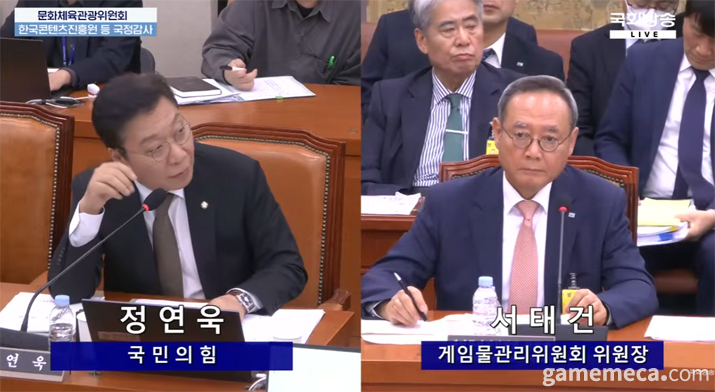
During the parliamentary audit on the 23rd, the issue of 'duplicate rating'—where developers must pay for new ratings when porting games to different platforms—was brought to light. However, as this issue has already been resolved across PC, mobile, and console sectors, the fact-checking of the materials provided by the representative's office is being called into question.
During the Culture, Sports and Tourism Committee audit on the 23rd, Representative Jeong Yeon-wook challenged GRAC Chairman Seo Tae-geon on various aspects of the game rating system. 'Arcade and web-board games require separate reviews per platform,' Jeong argued. 'Charging 3 million won for PC and then double-billing for consoles feels redundant. Why should they pay twice for the same game?'
However, this 'duplicate rating' problem was largely put to rest back in 2020 when the GRAC amended its regulations. Under current rules, if you port a game from PC to mobile or console, your existing rating remains valid. You don't need a fresh review. Chairman Seo confirmed this, stating, 'We do not charge duplicate fees, nor do we issue double billing. Developers can simply check the 'content modification' box to port platforms at no extra cost.'
Of course, arcade and web-board games are a different case due to gambling concerns, making them harder to treat like standard PC or console titles. Because the initial materials from the office failed to specify this distinction, the narrative of 'duplicate rating' has already spread across various media outlets. It is a point of confusion—it leaves the public thinking a problem solved five years ago is still plaguing the industry today.
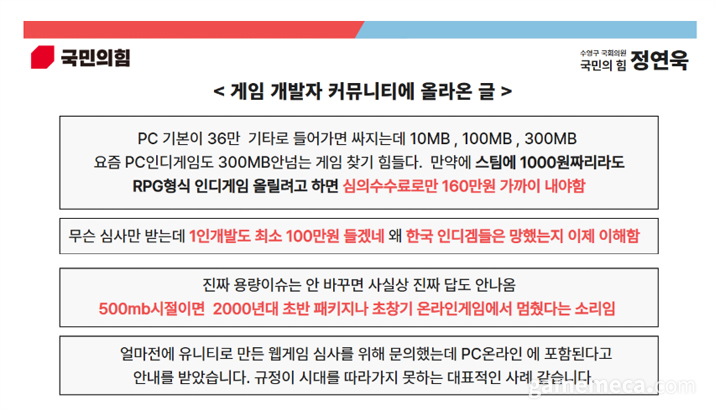
That said, Representative Jeong did raise some valid points. For instance, the base fee threshold for PC games—set at 300MB—is outdated. He also questioned the logic of charging a 500,000 won 'business trip fee' when the Busan-based GRAC travels to inspect games within Busan itself.
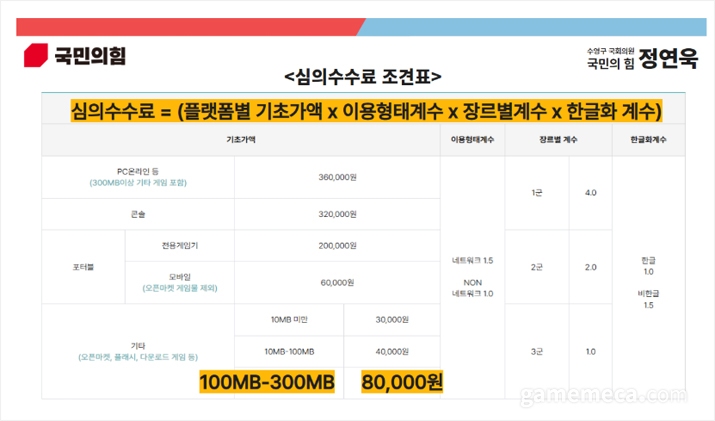
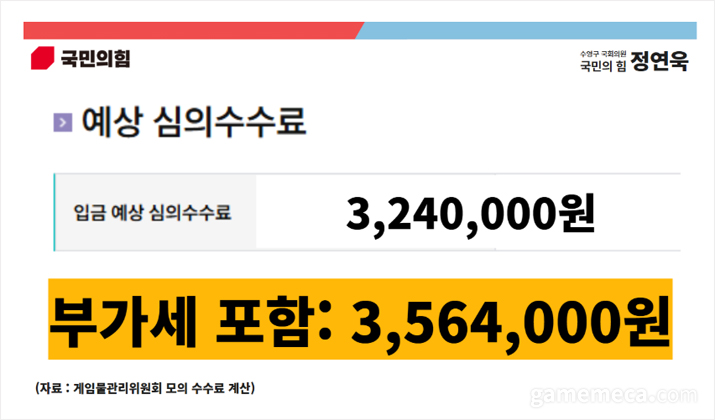
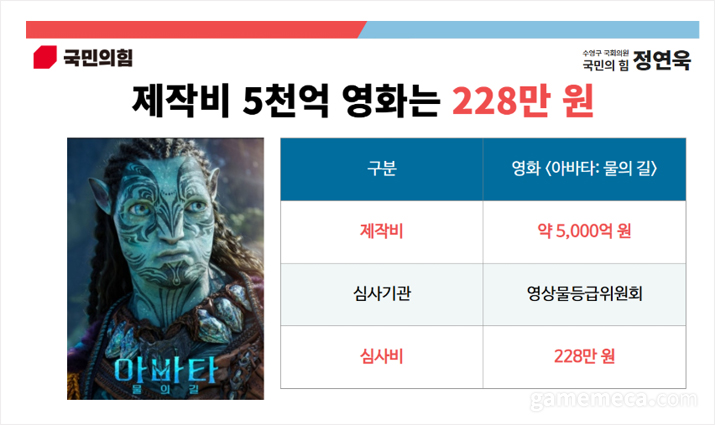
Representative Jeong argued that under current calculations, PC game rating fees could exceed 3 million won. He compared this to the 2.28 million won fee for the blockbuster movie 'Avatar,' which cost 500 billion won to produce, suggesting that the game industry is being squeezed unfairly—a burden he fears will crush the creative spirit of indie developers.
However, comparing a game to a three-hour film is difficult. A three-hour game is considered 'short'; most titles run for ten hours, and some push well over a hundred. While reviewers do check trailers and gameplay footage, the sheer volume of content in a game requires significantly more effort than a standard movie, making direct comparisons somewhat complex.
Chairman Seo responded: 'Our rating fees are roughly 50% to 10% of what you’d see overseas. Furthermore, these fees fund our entire operation—we receive no state funding for rating processes or travel expenses. Every won we collect reduces the burden on the national budget.'
On the subject of on-site inspections, he added, 'In principle, all arcade cabinets should be brought to us. We visit sites as a courtesy. Shipping those massive machines can cost up to 800,000 won round-trip. Even so, if the industry feels the burden, we are willing to work toward more realistic solutions.'
23일 열린 국정감사에서 동일 게임을 다른 플랫폼으로 낼 경우 또 심의를 받아야 하는 ‘중복 심의’ 문제가 지적됐다. 이 부분은 PC, 모바일, 콘솔 등에서 모두 해소된 상황이기에, 의원실에 대한 자료준비 미비에 지적이 일었다.
국민의힘 정연욱 의원은 23일 열린 문화체육관광위원회 국정감사에서 게임물관리위원회(이하 게임위) 서태건 위원장을 상대로 게임 심의에 관련된 여러 문제를 지적했다. 정연욱 의원은 “아케이드게임, 웹보드게임 같은 경우에는 플랫폼별로 나눠서 심사한다. PC용으로 300만 원 내고, 콘솔에는 또 이중청구하는 형태다. 같은 게임인데 두 번 돈을 내야 하나”라고 지적했다.
그러나 중복 심사는 2020년에 게임위가 관련 규정을 수정하며 대부분 게임에서 없어진 문제다. 현재 규정을 살펴보면 PC, 모바일, 콘솔 게임은 동일한 게임을 다른 플랫폼으로 제공할 경우 기존의 등급분류 효력이 유지된다고 되어 있다. 같은 게임을 PC로 심사를 받고, 콘솔로 낼 경우에는 심의를 또 받지 않아도 된다. 게임위 서태건 위원장 역시 “중복 수수료를 받지 않으며, 이중청구를 하지 않는다. 내용수정신고에 체크하면 무료로 플랫폼 전환이 가능하다”라고 말했다.
이어서 아케이드와 웹보드게임의 경우 사행 운영 우려로 인하여 일반적인 PC, 모바일, 콘솔과 동일하게 취급하기 어려운 측면이 있다. 여기에 의원실에서 정정 이전에 배포한 자료에는 ‘아케이드와 웹보드게임’이라는 언급이 없었기에, 이미 매체 다수에 PC와 콘솔 간 중복 심의 문제가 언급되어 있다. 국민 입장에서는 일반적인 게임에 대해서는 5년 전에 해소된 문제가 지금도 지속되고 있다고 오해할 수 있다.
물론 정연욱 의원의 세부 내용 중 타당한 점이 없었던 것은 아니다. PC게임의 경우 300MB 이상의 심의수수료 기초가액이 30만 원으로 되어 있는 부분은 현재 시류에 맞지 않는 체계라는 점, 아케이드게임 출장 심사 시 부산에 있는 게임위가 부산으로 출장심의를 갈 때도 50만 원에 해당하는 수수료를 추가로 받는다는 점은 적절하지 않다는 지적 등이다.
정 의원은 PC게임을 토대로 산정하면 심의수수료가 300만 원 이상이 부과될 수 있다는 점을 지적했다. 5,000억 원에 달하는 제작비가 소요된 영화 아바타의 심사비가 228만 원이라는 점에 빗대어 게임 심의 수수료가 과도하다고 주장했다. 이러한 부분은 특히 소규모로 게임을 만드는 인디게임 개발자들의 창작 의지를 꺾을 수 있다고 우려했다.
다만 영화는 3시간 내외 길이다. 반면 게임의 경우 3시간이면 ‘짧은 게임’에 속하며, 플레이 타임이 기본적으로 10시간 이상에, 100시간 이상까지 늘어나는 경우도 종종 있다. 물론 심의 과정에서 게임사가 송부한 영상을 참고하는 부분이 있으나, 영화에 비해 콘텐츠 심의에 소요되는 품이 큰 편이다. 따라서 영화와의 직접 비교는 다소 어려운 측면이 있다.
서태건 위원장은 “우리나라 심의료는 해외와 비교하면 적게는 50%에서 많게는 10분의 1 수준이다. 아울러 등급심의에 들어가는 모든 비용과 출장비는 국비를 받지 않고 수수료를 토대로 운영 중이다. 수수료를 받은 만큼은 국비를 청구하지 않는다”라고 전했다.
이어서 출장심사에 대해서는 “원칙적으로는 모든 아케이드 게임은 게임위에 입고되어야 한다. 편의상 큰 게임기는 저희가 가서 심의해드리는 것이다. 그분들이 큰 게임을 입고할 경우 트럭을 동원해야 하는데 그 비용이 왕복 80만 원에 달하는 때도 있다. 그렇다고 하더라도 업계에서 부담가는 부분이 있다면 현실화할 수 있는 부분을 개선해나갈 수 있도록 노력하겠다”라고 답했다.
This news was translated by AI.

Let's not lose our initial resolve. Meticulously, one by one. risell@gamemeca.com
RECOMMENDED NEWS
MOST POPULAR NEWS
- [Today's steam] Aion 2 Records 400,000 Concurrent Players Upon Official Launch
- Is something big coming? Nikke 4th Anniversary Special Broadcast to air on the 24th at 7 PM
- "Cannot even log in" Steam blockades intensify in Vietnam
- [Today's steam] Valve's new title 'Deadlock' surpasses 230,000 Concurrent Players
- Representative Cho Seung-rae: "Gamescom's Strength is Strong B2B, Desperately Needed for G-Star"
- Pre-load starts for World of Dokkaebi, releasing on October 8
- 'Dave the Diver' Complete Edition Released with All Expansions
- "Destined to Disappear Anyway" CyberConnect2 CEO Supports Abolishing Physical Discs
- [Cartoon] The arrival of the sharpshooter 'Aion 2'?
- Dokkaebi World Achieves Number 1 Popularity on Both Major App Markets on Launch Day
MEDIA PARTNERSHIPS



GAMEMECA SNS


 GAMEMECA GLOBAL SITE